07 25th September 2016
They summoned her to the headmistress’s office on Monday afternoon, in the middle of her third week. The appointment had been on her timetable since she arrived: twenty minutes at the end of the school day, when lessons were finished and the girls were making their way back to the accommodation blocks.
Julia arrived five minutes early. The antechamber was occupied by a secretary whose principal function seemed to be not seeing children. She was clearing her desk, dropping papers into drawers and fastening the clips of a leather handbag. Beyond her, the double doors to Miss Milne’s office were closed, their opaque glass etched with the school’s Latin motto: In Veritate, Virtus. Julia had already translated it, checked the translation and tried several alternatives of her own.
She sat beneath the hum of a fluorescent tube and rehearsed what she might be asked. Lessons. Food. Room 204. Victoria. Charlotte.
The secretary put on her coat. “Miss Milne will call you.”
Julia looked at the clock above the outer door. “Thank you.”
The woman left without replying. Her footsteps diminished along the corridor and the fire door closed behind her with a heavy click. Two minutes later, a buzzer sounded on the empty desk.
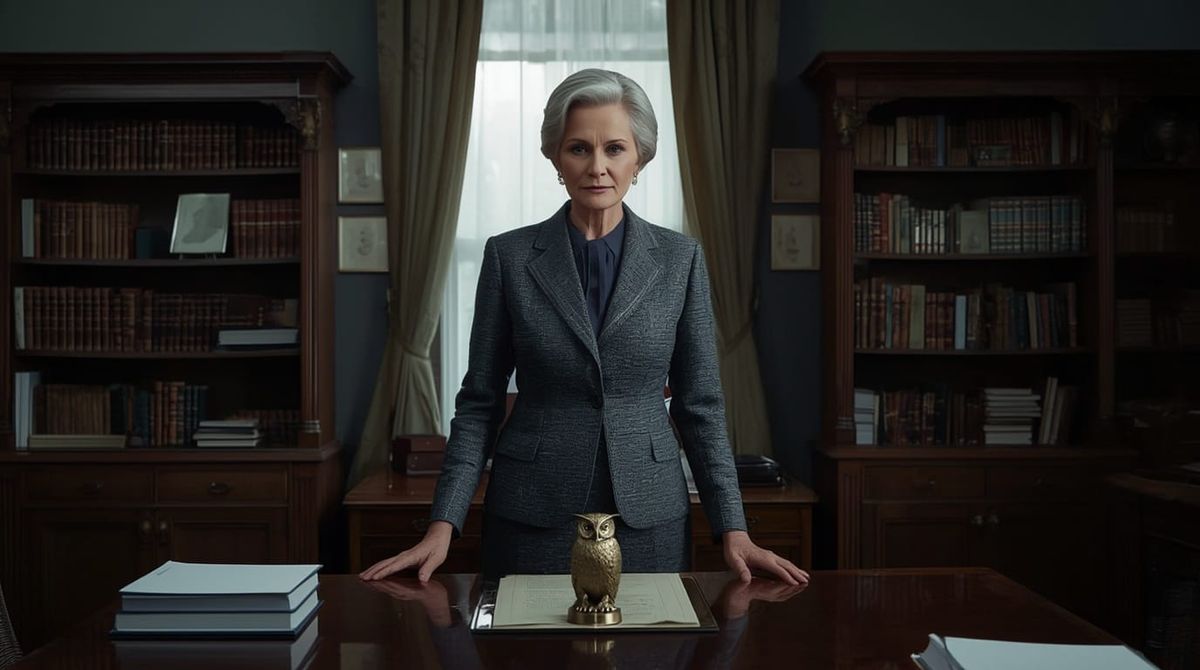
Miss Milne’s office was as orderly as the antechamber had been bare. Books filled the shelves behind the desk, grouped by subject and then, within each section, by height. The blotter lay square with the desk edge. Beside it stood an antique brass owl with scratches across its eyes.
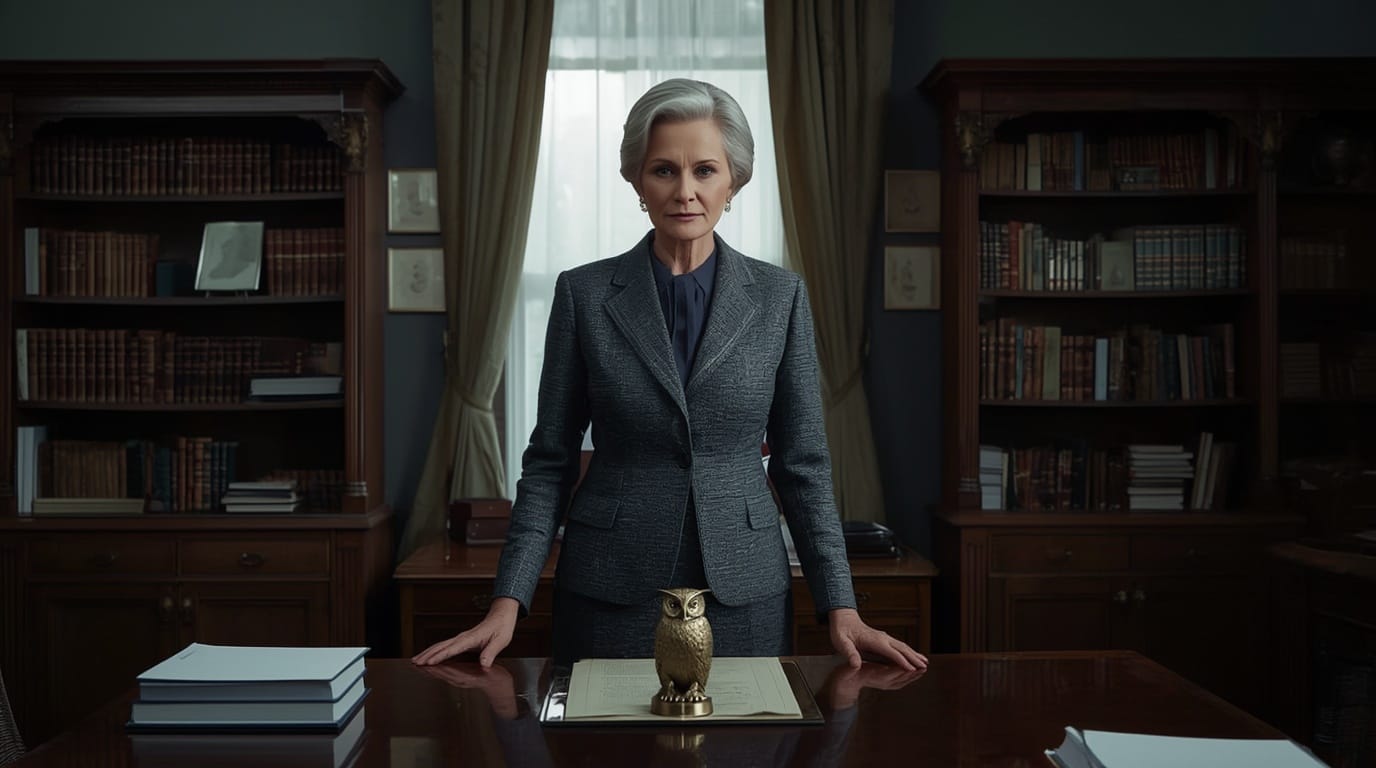
Miss Milne rose to greet her. She was tall and spare with immaculate silver-grey hair. Julia had seen her in assembly, but at close quarters the narrowness of her face was more pronounced, as was the economy with which she moved.
“Miss Holloway. Please, sit.”
Her grip was dry and unexpectedly strong. Julia perched on the front of the chair, knees together, the way people did in television interviews when they wanted to appear attentive and slightly afraid.
Miss Milne sat and looked at her for long enough to make the silence part of the question.
“How are you finding St Teresa’s?”
“It’s different from my last school.”
“That was rather the intention, I understood.”
Julia kept her attention on the owl. “Yes.”
“Different in what way?”
She considered the answers available to her. “It’s more organised. People know their place.”
“Do you?”
Julia looked up. “I think so.”
Something moved at the corner of Miss Milne’s mouth. She opened the file in front of her.
“Your teachers report that you are settling well. Your work is more than satisfactory. You are quiet, but there are worse faults.” She turned a page. “You have not yet made any particular friends.”
“People are kind. It takes me longer.”
“And Miss Harrington-Wells?”
“Victoria helps me.”
Miss Milne looked at her over the file, then lowered her eyes to the page again.
“I remember your family,” she said. “I taught your mother when she was here. Only briefly, during her sixth-form years, but Charlotte was not a pupil one readily forgot.”
Julia waited.
“Your grandmother attended every school event. She took a close interest in your mother’s education.”
It was a careful description of Eleanor. Julia wondered whether Miss Milne had practised it.
“Is your mother in regular contact?”
“She’s busy.”
“Of course.” Miss Milne paused. “Boarding school can magnify an absence at first. If you find that happening, your form tutor should know.”
Julia nodded. The brass owl blurred briefly, and she blinked it back into focus.
Miss Milne returned to the file. “Miss Jordan tells me you have a marked aptitude for Computer Science. She believes you may already be ahead of the class.”
“I’ve practised a lot.”
“Your previous school said much the same.” Miss Milne folded her hands over the open file. “They also suggested that your enthusiasm sometimes carried you beyond what was expected.”
The blue login box returned to Julia: the flat rectangle and the cursor blinking beneath it.
“I understand.”
Miss Milne watched her for a moment before closing the file. “Is there anything you wish to ask me?”
Julia lowered her eyes. She had planned several ways to begin, but each now sounded rehearsed. Her fingers tightened around the edge of her blazer sleeve.
“I’ve been getting dizzy.”
“Since you came here?”
“I had it before. Sometimes in assembly, or if I’ve been standing for a long time.” Julia swallowed. “It’s worse after games. I didn’t want to make a fuss.”
“Have you seen the nurse?”
Julia shook her head and changed her breathing, not dramatically, only enough to make the next breath fail to fill her lungs. She fixed her eyes on the scratches across the owl’s face and tried not to blink. The dark specks that gathered at the edge of her vision were expected; the sudden lurch beneath her ribs was not.
“Miss Holloway?”
She reached for the chair as though the room had shifted, caught its edge badly and knocked her knee against the desk. Miss Milne was beside her before the pain had cleared.
“Stay where you are.”
She opened the office door. “Mrs Pritchard?”
The empty antechamber answered her. Miss Milne glanced at the clock, then along the corridor.
“The nurse will be making her round of the houses by now.” She returned for the glass carafe on her desk and poured water. “Sit back. Do not attempt to stand. I shall bring her.”
Julia accepted the glass in both hands. Miss Milne hesitated at the door and looked back at her.
“I won’t move,” Julia said.
The door closed. Julia listened to the footsteps cross the antechamber and continue into the corridor. She waited for the fire door, but when it came the noise was lost beneath voices outside and she was no longer certain she had heard it.
She put down the water. Her hand shook hard enough to set the surface trembling.
She saw two drawers on the side of desk closest to her, and after a moment of indecision she opened them. Nothing of interest.
Then she got up and went round to the far side, into Miss Milne’s territory, and examined the desk from behind her chair.
The desk drawers were fitted flush into both pedestals. Julia tried the top right one. Stationery, a spectacle case, a packet of peppermints. The drawer beneath held hanging files, and she pushed it back before the metal runners had fully opened. On the left, the first drawer was locked. She looked at the office door, then pulled at the narrow central drawer beneath the blotter.
It slid towards her.
Two keys lay inside on separate rings, beside a box of drawing pins and a stack of old appointment cards held together with an elastic band. One key was small and flat. The other was heavier, with a long stem and a double-cut bit unlike the keys used on the classroom doors. Partly covered by the appointment cards, a yellow Post-it carried six digits in Miss Milne’s precise handwriting.
Pipes knocked somewhere in the wall. From the grounds below came the shouts of girls crossing towards Malvern, then a whistle and the slam of an outside door. Julia took out her phone, but the first photograph blurred into pale streaks because her hand was still shaking. She took another and enlarged it until all six numbers were clear.
The heavier key remained in the drawer. There was no label and nothing to prove what it opened, but at the parish office the safe her father had used when counting donations had taken a key of the same old-fashioned shape.
Julia lifted it. For several seconds she stood behind Miss Milne’s desk, listening, the key warm in her closed hand. Then she crossed to the shelves.
The lower section was concealed behind wooden doors. The first contained bound copies of governors’ reports and a bottle of sherry. Behind the second, set back beneath the lowest shelf, was a dark metal safe.
She crouched and put the key into the lock. It fitted, but would not turn. Above the keyhole was a numerical display which remained blank until she touched it; four empty spaces appeared.
Julia looked at the six-digit number on her phone. The sounds from the grounds had gone. In the office, she could hear the fluorescent tube in the antechamber and a faint movement that might have come from the corridor or the pipes.
She thought of trying a date, any date, only to see what the safe did with a wrong answer. Instead, she withdrew the key, closed the cupboard and returned to the desk more quickly than she intended. She had learned enough to know that the six-digit number belonged somewhere else. She had no idea where Miss Milne was or how long it would take her to find the nurse.
The appointment cards had shifted. Julia pressed them back beneath the elastic band and set the key down with its bit facing the same direction, although she could no longer remember whether the ring had rested above or below the smaller one. She closed the drawer and sat down.
A wet ring marked the polished surface where the water glass had stood. She wiped it with the cuff of her blazer, then stopped in case the smear was worse than the ring and rubbed at it again. The fire door opened at the end of the corridor while the cuff was still damp.
Julia picked up the glass and leaned back in the chair. Her heart was beating hard enough to drain the colour from her face, and by the time Miss Milne entered with the nurse she was no longer pretending that her hands were unsteady.
The nurse smelled faintly of menthol and outdoor air. She set a leather case on the desk and crouched in front of Julia.
“Tell me what happened.”
“I felt dizzy.”
“Did you lose consciousness?”
“No. I don’t think so.”
“Breakfast?”
“Yes.”
“Lunch?”
Julia nodded. The nurse took her pulse and watched the second hand of Miss Milne’s clock. Julia concentrated on keeping still.
“You’re pale,” the nurse said.
“She became unsteady quite suddenly,” Miss Milne said.
The nurse looked from her to Julia. “Any previous episodes?”
“Sometimes. At my old school.”
“And your mother knows?”
“My mother has low blood pressure.”
The nurse opened her case. “We’ll check yours. Then you can come with me and lie down for half an hour. If this has happened before, I shall need to speak to your mother and the doctor.”
Julia looked at Miss Milne.
“That is sensible,” Miss Milne said. “You should have told someone earlier.”
“I didn’t want people to think I couldn’t cope.”
The nurse wrapped the cuff around Julia’s arm and began to inflate it. The pressure tightened above her elbow. On the desk, beside the abandoned file, the brass owl faced the window.
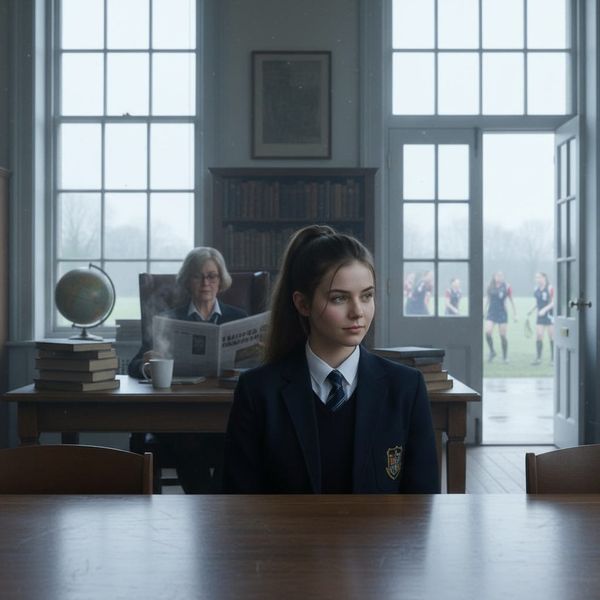
By the time Julia returned to Malvern, the corridor lights were on and rain had begun to stipple the windows. Victoria sat on the sill in Room 204, one foot braced against the radiator while she painted her nails a colour just dark enough to test the uniform rules.
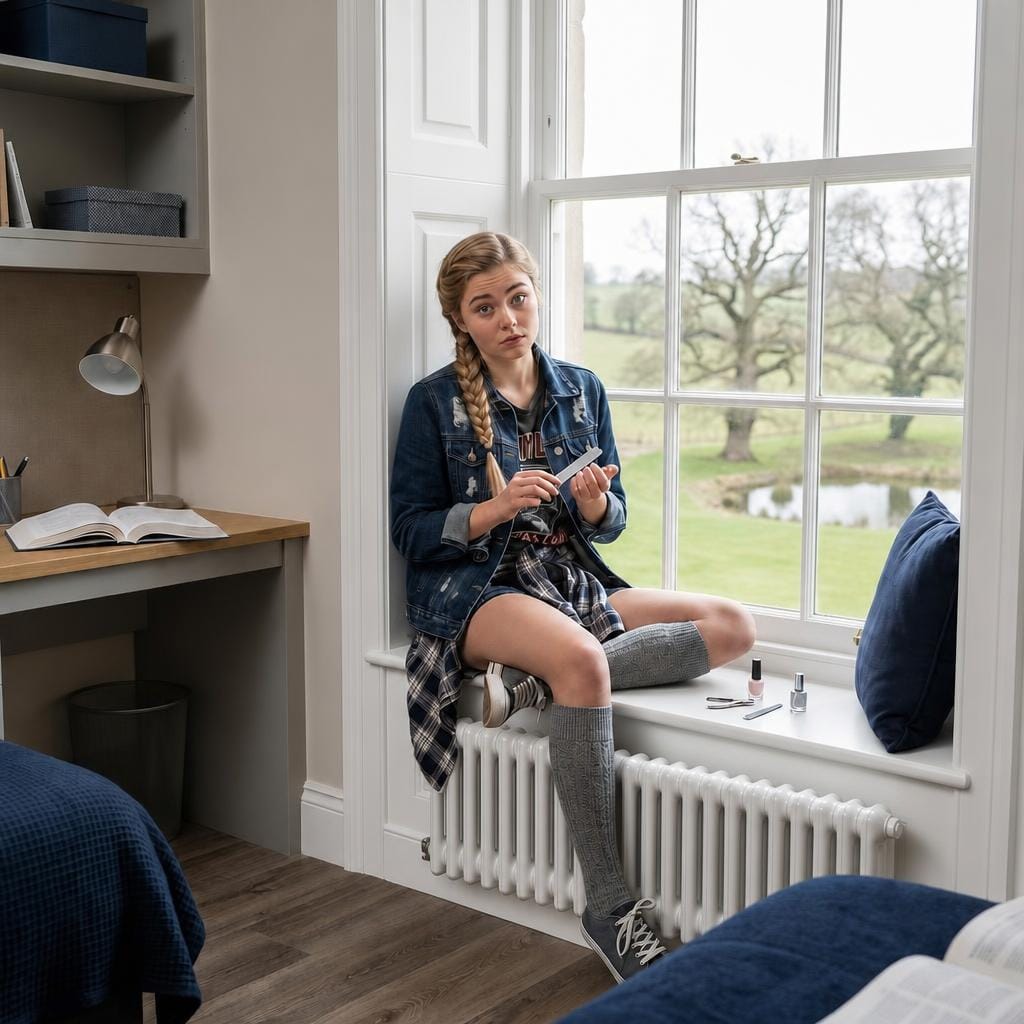
“Where were you?” she asked without looking up.
“Miss Milne wanted to check that I was settling in.” Julia put her bag beside the bed. “Then I felt faint.”
Victoria glanced at her. “God. Are you all right?”
“The nurse says I should rest.”
“You are alarmingly good at that.” Victoria bent over her thumbnail again. The smell of the nail varnish mixed with the radiator’s metallic heat. “Milne scares the crap out of most girls.”
Julia sat on the edge of her bed and began to unfasten her shoes.
“What did you talk about?”
“My work. My mother. You.”
The brush stopped halfway to Victoria’s nail. “Me?”
“She asked if you were helping me settle in.”
Victoria considered this, then resumed painting. “What did you say?”
“Yes.”
“Good answer.”
Julia looked across at her. Victoria’s attention remained on the careful dark curve of her thumbnail.
After lights out, Julia waited until Victoria’s breathing had settled. She drew the duvet over her head and opened the photograph on her phone. The first image was useless, the numbers dragged into pale streaks. In the second they were sharp enough to copy into the back of her logic puzzle book, divided into three pairs. She deleted both photographs and cleared the deleted folder.
Then she lay in the dark, listening to the rain and the slow hiss of the pipes. She could still feel the weight of the heavier key across her palm. When she opened her hand there was nothing there, but the sensation remained.
Listen to the episode here