08 October 2016
The diagnosis—functional, not anatomical—was written in a faint, apologetic hand: vasovagal episodes, likely stress-induced; recommend excusal from strenuous activity.
The nurse read it twice before placing it in Julia’s file.
“This doesn’t excuse you from all exercise,” she said. “You may walk. You may swim if someone is supervising. But no cross-country, no competitive games and no standing about on cold pitches until we have a clearer idea what brings these episodes on.”
Julia lowered her eyes. “All right.”
“You should have told us sooner.”
“I didn’t think it was important.”
The nurse looked at her over the top of the page. Julia had discovered that adults disliked being told they had been deceived, but responded more generously to the suggestion that a child had underestimated her own suffering.
“It is important,” the nurse said. “You’ll report to the library during games. The librarian will have work for you.”
With this, Julia was granted the rarest of commodities at St Teresa’s: unsupervised time.
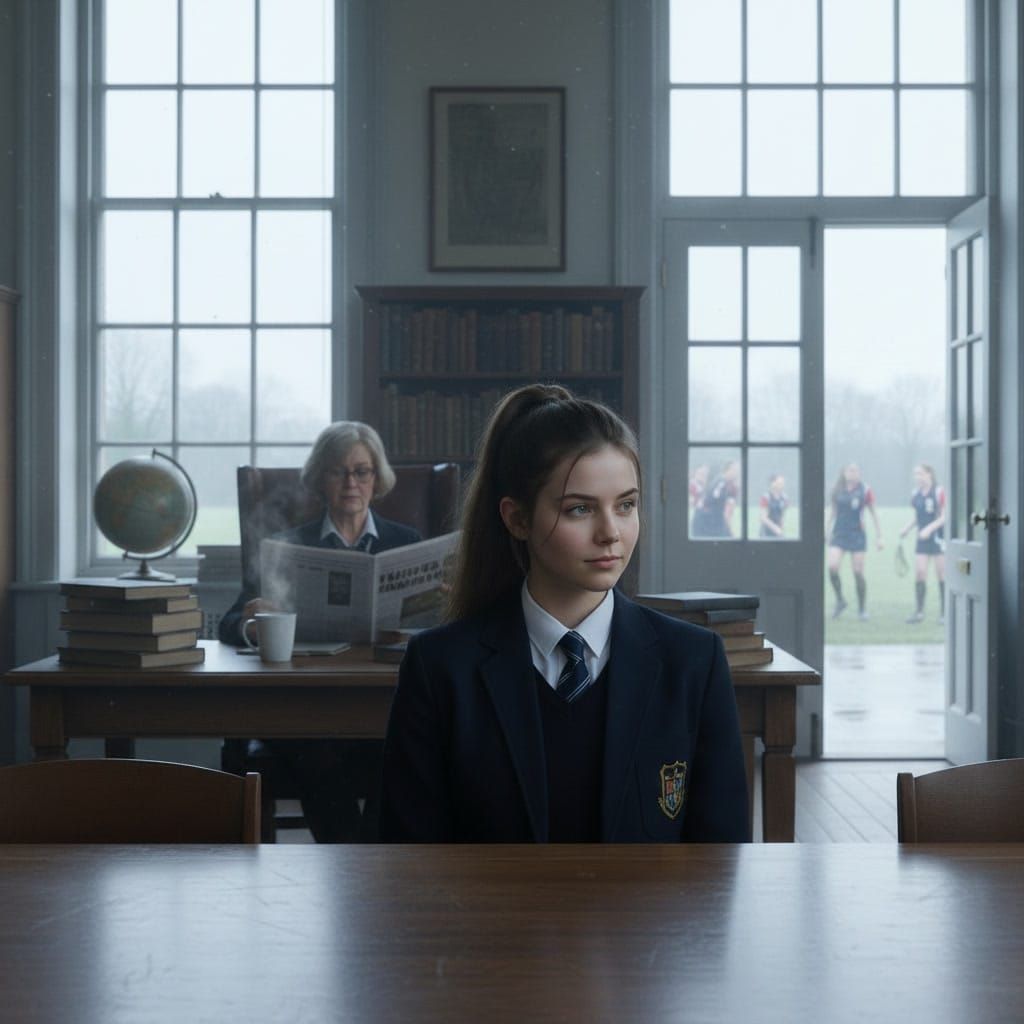
While her year group slogged through muddy lacrosse practice, she was assigned to the library, a space so over-lit and under-populated it felt like an abandoned stage set. The librarian, an ageless woman with a nicotine cough and a fortnightly perm, paid no attention so long as Julia signed the attendance sheet and stayed clear of the archival stacks.
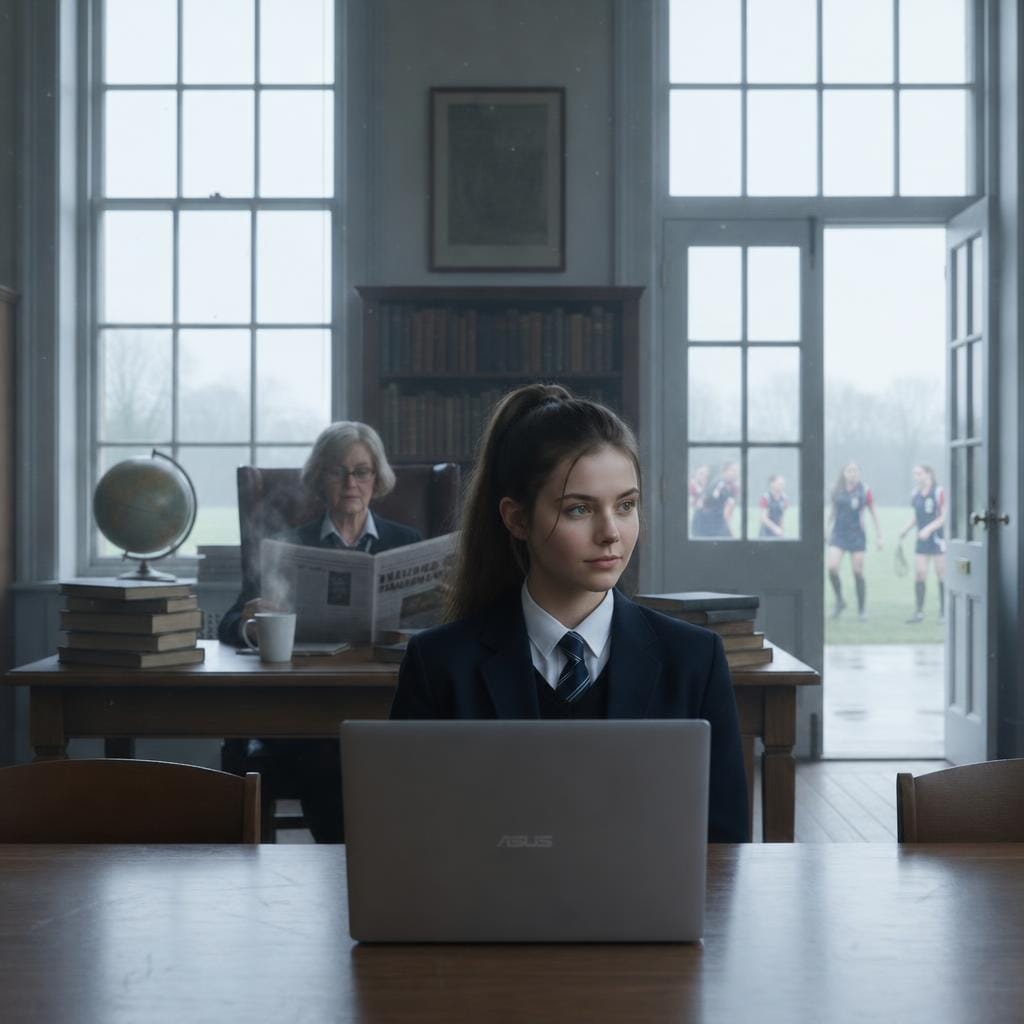
For the first few days, Julia remained at the same table beneath the librarian’s desk, unsure how closely the woman was watching. The shouts from the lacrosse pitch reached her whenever the library doors opened. She kept her head down until she understood that the librarian’s attention rarely travelled beyond her newspaper and the mug at her elbow.
After that, Julia began to explore.
She did not go far at first. The corridor behind the print room had no camera she could see, although a smoked plastic dome above the fire door made her uncertain. The cleaners came through at roughly the same time each afternoon. Some teachers locked their offices during break; others merely pulled the doors shut. Julia noted each variation and returned to the library before an absence could become noticeable.
Her favourite refuge was the small room at the back of the library labelled Reference Only. Inside, battered yearbooks, school magazines and decades of examination papers formed haphazard towers. The Wi-Fi signal was inexplicably stronger there than elsewhere in the school, but the blue staff login remained closed to her. She tried the credentials used in the computer room, once with her own username and once without it, then stopped. Repetition might be recorded even if failure was not.
The six-digit number on her phone had already been deleted. She had copied it into the back of her logic puzzle book as three pairs, beneath a row of trial answers that made it look unimportant. She looked at it sometimes without knowing what it belonged to.
The answer appeared during her second week in the library.
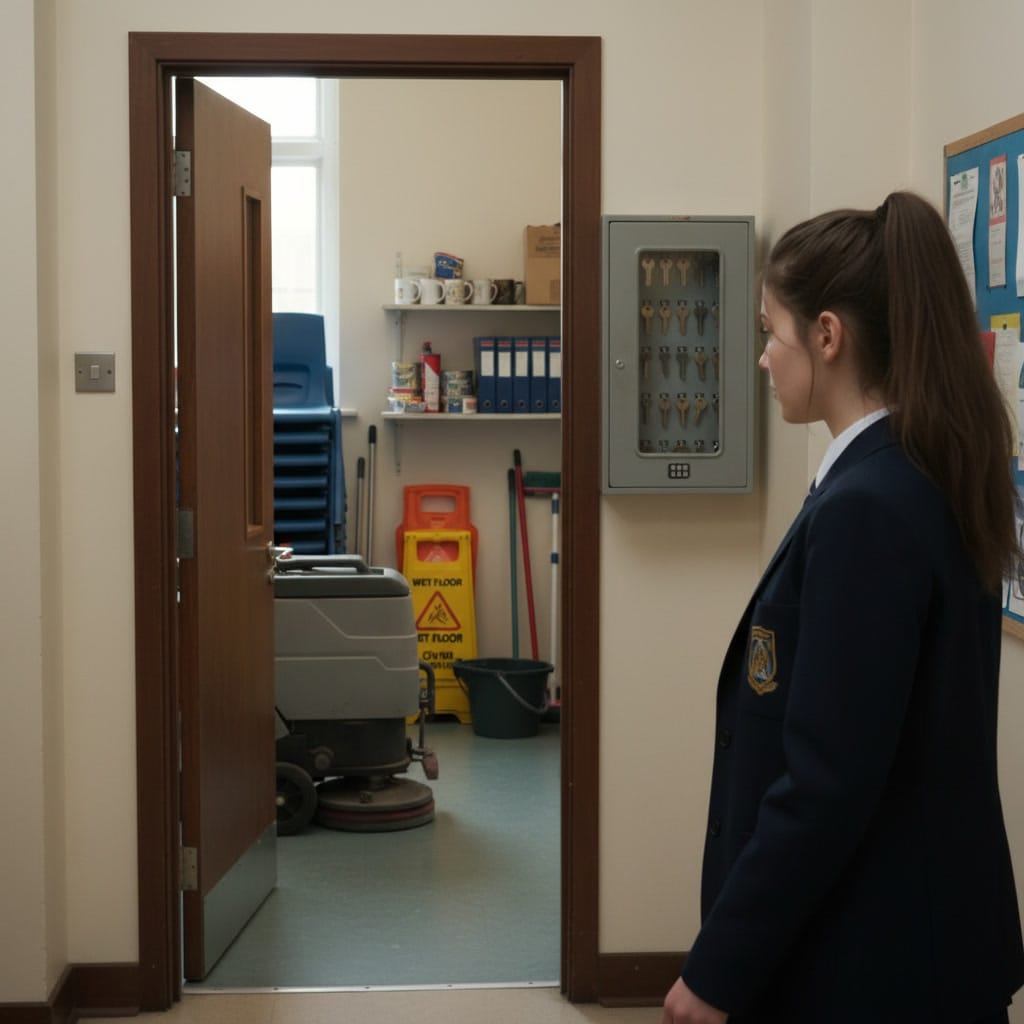
A caretaker had propped open a door beside the back stairs while he manoeuvred a floor-polishing machine through it. The corridor beyond contained stacked chairs, folded signs and a smaller room with cleaning and other equipment. Julia passed without slowing. On the wall outside the cupboard, was a grey metal cabinet with a narrow glass panel. Keys hung in rows behind it. A series of six buttons were under the glass door.
Six buttons would have meant nothing by themselves. Together with the number from Miss Milne’s drawer, they became a possibility.
She continued to the library and took her usual seat. The librarian marked something in the newspaper with a ballpoint pen. Outside, a whistle travelled across the pitch, followed by a distant complaint and laughter.
Julia opened her logic puzzle book but did not turn to the final page.
For three afternoons she watched the door to the caretaker’s corridor. The door was usually locked. Shortly after four, one of the cleaners collected a ring of keys from the caretaker and returned it before going home. On Thursday the caretaker opened the cabinet himself. Julia was too far away to see the numbers, but she counted six movements of his hand before the catch released.
The next Tuesday, the door stood open again. A radio played somewhere beyond the shelves, and water ran into a bucket. Julia crossed the corridor as if looking for a toilet and stopped beside the cabinet.
Its contents were less impressive at close quarters. Each hook held a numbered disc and one or two keys. A typed list behind the glass assigned them to rooms and buildings: science preparation, chapel vestry, archive, stationery, administration. Several hooks were empty. There was no single master key and no ring large enough to open the whole school.
Julia entered the six digits.
For a moment nothing happened. Then a green light showed above the keypad and the catch released with a soft mechanical click.
She did not open the door.
The water stopped in the room behind her. Julia walked on, entered the nearest lavatory and remained there until she heard the bucket wheels cross the corridor. When she returned to the library, the space beneath her ribs felt loose and unpleasant, as it had in Miss Milne’s office after the dizziness ceased to be entirely pretend.
She had physical access now, but only while the building around the cabinet was awake. Using it would require a reason to be in that corridor, an empty hook that might be noticed and enough time to return the key before anyone reached for it.
The key to the headmistress’s office was numbered eighteen.
Julia found that out without touching it. She compared the typed list with the discs behind the glass, then copied the number into the margin of a page of algebra. Other keys interested her because they explained the shape of the school: which spaces belonged together, which doors the staff expected to keep separate. She learned the position of the cameras by approaching from different corridors and watching for the small red lights. She timed the automatic locks. She discovered that the fire door beside the music rooms could be opened from inside without sounding an alarm and took eleven seconds to close.
Nothing happened quickly. Some Wednesday afternoons she did no more than sign the attendance sheet and read. She also began visiting at the end of the school day before the library closed at five pm. The librarian occasionally looked up when Julia returned from the Reference Only room, and for several days afterwards Julia stayed where she could be seen.
The safe remained a different problem.
The old-fashioned key was in Miss Milne’s desk, but the four empty spaces above the lock meant that possession of it would not be enough. Julia began with the dates anyone might choose: a birthday, a marriage, the foundation of the school. Miss Milne’s age was easy to estimate and difficult to prove. The school had existed for more than a century, with several dates claimed as beginnings depending on whether the convent, the first classroom or the present institution was meant.
In the Reference Only room, Julia worked backwards through school magazines.
Miss Milne appeared frequently in the recent ones: opening a science block, presenting a hockey trophy, standing beside governors whose names changed more often than hers. Older photographs softened her hair and widened her clothes but did not make her expression less guarded. .
Before becoming headmistress she had taught history. Before that, she appeared only sporadically: opening a charity fête, supervising a debating competition, standing at the edge of photographs where the students occupied the foreground.
One issue contained a full-page photograph of the Upper Fifth gathered on the steps outside the chapel. Julia recognised her mother at once, despite the grainy print and the ridiculous hair. Charlotte stood in the second row, turned slightly towards another girl as if speaking just before the shutter clicked.
At one end of the group stood a much younger Miss Milne.
The caption identified the year as 1984.
Julia looked at the photograph for longer than she intended. Her mother had rarely spoken about school. Looking at the image now felt like discovering evidence from a period that everyone else had agreed to leave undocumented. A paragraph on the facing page welcomed Miss Veronica Milne, a recent graduate, to the history department and the pastoral staff of Malvern House. Twenty-one, perhaps twenty-two. The beginning of an adult life in a place that had since become inseparable from her.
She wrote 1984 on a scrap of paper, looked at it, then tore the paper across the numbers and again into smaller pieces. It was plausible enough to try. It was not proof.
By then she knew that the administration corridor was empty between the cleaners leaving and the night matron making her first circuit. The interval varied. On two evenings it was twenty-three minutes; on another, only fourteen. Julia watched from the stairwell and did nothing.
The next problem was getting out of Malvern.
Victoria slept deeply but not predictably. Some nights she whispered to Helena through the wall or remained beneath her duvet with the blue light of her phone against her face. On others she was asleep before the corridor settled. Julia waited until she understood the noises of the block: the bathroom door with the loose hinge, the radiator that knocked shortly after midnight, the soft tread of the matron and the pause outside each dormitory.
She chose a Wednesday when rain had cancelled an evening fixture and left the girls tired and irritable. At one twenty-seven, Victoria’s breathing was slow and even. Julia dressed beneath the duvet, put on her shoes at the door and carried them along the corridor in her hand.
The school at night was not silent. Pipes moved in the walls. Emergency lights gave the stairwells a diluted green glow, and wind pressed intermittently against the old window frames. Julia crossed the covered walkway to the main building and waited beside the music rooms while the fire door eased shut behind her.
The caretaker’s corridor smelled of polish and damp cloth. She entered the six digits into the cabinet. The green light appeared.

This time she opened it.
Number eighteen hung in the second row. Julia removed the key and closed the cabinet. The absence showed immediately: an empty hook, a gap in the descending line of numbered discs. She would have to return it before morning.
The key opened the outer administration door. Julia stood in the dark antechamber, listening. The desk where the secretary had packed her handbag was a block of deeper shadow. Beyond it, the opaque glass of Miss Milne’s double doors held the green reflection of the exit sign.
Number eighteen turned in that lock as well.
Miss Milne’s office retained a faint daytime smell of furniture polish and peppermint. Julia did not switch on the light. She closed the door without letting the latch snap and waited for her eyes to adjust. The brass owl was a dark shape on the desk, its scratched eyes catching what little light came through the glass.
As her eyes adjusted, shapes emerged from the darkness: the brass owl on the desk, the bookcases along the wall and, beside the filing cabinet, a framed photograph she recognised from the library archive.
Even in the dim light she could make out her mother's face among the girls and the younger Miss Milne standing at the edge of the group. There was no date on the image but Julia considered the image.
Miss Milne had kept the photograph for more than forty years. Julia filed that fact away and opened the drawer. The appointment cards were still held beneath their elastic band. The safe key lay beside the smaller one, its bit facing towards the window. Julia lifted it and crossed to the shelves.
The cupboard door made no sound. When she touched the numerical display, four empty spaces appeared.
She entered 1984.
The display remained unchanged for a second. Julia thought she had been wrong. Then a small amber light turned green and something released inside the door.
The physical key turned.
The safe contained no money. Two document wallets stood upright beside a cash box, a sealed packet and several folders marked with financial years. Julia opened the first wallet far enough to read the label and replaced it. The second held a series of typed sheets in transparent sleeves: emergency procedures, supplier contacts and instructions for restoring the school’s network after a failure.
Halfway down the second page, beneath the heading Administrator Access, were a username and password.
Julia took out her phone. The screen seemed too bright even at its lowest setting. She covered it with one hand, photographed the page and checked the image once. The words were clear.
She returned the sheet to its sleeve, the sleeve to the wallet and the wallet to the same side of the safe. Then she locked it, wiped the keypad with her cuff and replaced the heavy key in the desk drawer. Its ring rested above the smaller one. She thought that was how it had been before.
Number eighteen returned to its hook in the caretaker’s cabinet. Each restoration reduced the evidence of her passage but did nothing to slow her heart.
She reached Malvern at two fourteen. Victoria moved when Julia opened the door, turning towards the wall and drawing the duvet higher over her shoulder. Julia stood without breathing until she settled.
Only then did she take off her shoes.
At her desk, with the duvet hung around her shoulders, Julia opened the photograph. The username contained Miss Milne’s initials. The password was longer than she had expected, with two capital letters and a number at the end. She copied both onto paper before deleting the image and clearing the deleted folder.
The blue login box appeared on her screen. Julia entered the username and password.
This time it opened.
Behind it were the systems that had previously refused her: attendance, discipline, room bookings, reports and marks. Julia read the headings without selecting any of them. The radiator knocked in the wall, and Victoria shifted again in her sleep.
Julia closed the computer.